

Learning Module 2.
Electromagnetic Radiation & Electromagnetic Spectrum
Introduction
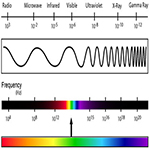 Electromagnetic radiation or EMR is the term used to describe all of the different types of energies released by electromagnetic processes. Visible light is just one of many forms of electromagnetic energy. Radio waves, infrared light and X rays are all forms of electromagnetic radiation. The electromagnetic spectrum is the term used to describe to entire range of all possible frequencies of electromagnetic radiation. Remote sensing technologies rely on a variety of electromagnetic energy. Sensors detect and measure electromagnetic energy in different portions of the spectrum. Therefore it is important to understand the fundamentals of electromagnetic radiation.
Learning Outcomes
- Become familiar with the relationship between wavelength, frequency and energy
- Understand wave theory, particle theory, Stefan-Boltzmann law and Wein’s displacement law.
- Understanding the implications of electromagnetic radiation principles in the application of remote sensing
- Develop a working knowledge of the regions of the electromagnetic spectrum
- Perform calculations based on wave theory, particle theory, Stefan-Boltzmann law and Wein’s displacement law and work with and convert numbers in scientific notation and various metric pre-fixes
Readings
- Read pages 54-68 in Principles of remote sensing: An introductory textbook
Presentations and Content
- Electromagnetic Radiation
- How EMR is Measured
- Electromagnetic Spectrum
- Blackbody Radiation
- Scientific Notation