

Blackbody Radiation
The Sun is the primary source of electromagnetic radiation on Earth, but all objects warmer than absolute zero 0 °K (-273° C) reflect, absorb and emit electromagnetic energy. The amount of electromagnetic radiation an object emits depends primarily on its temperature. The higher the temperature of an object, the faster its electrons vibrate and the greater the energy emitted. Together the Stefan-Boltzmann Law and Wien's Displacement Law explain how much energy a body emits and in where in the electromagnetic spectrum peak radiation occurs. These laws are based on the idea that the energy source behaves as a blackbody. A blackbody is an theoretical body that absorbs all electromagnetic radiation falling on it. It is a hypothetical object which is a perfect absorber and a perfect emitter of wavelengths radiation. The term originates because for a blackbody all visible light will be absorbed rather than reflected, and therefore the surface will appear black. A star, like the Sun is a near perfect blackbody. A blackbody does not reflect any light, nor does it allow any light to pass through (transmit).
Stefan–Boltzmann Law
How much energy an object radiates (per a given surface area) is a function of the surface temperature of the object. This property is expressed by the Stefan–Boltzmann law:
M = σ T 4
M = Total energy emitted from the surface of a material (Watts/ m2)
σ = Stefan-Boltzmann constant, 5.6697 x 10⁻⁸ W/m2 K 4
T = Temperature of the emitting material in Kelvin
The Stefan-Boltzmann Law gives the total energy being emitted at all wavelengths by the blackbody. It is important to note is that the total energy increases rapidly with temperature, since it varies to the fourth power of the temperature. The primary parameter that determines how much light the blackbody gives off, and at what wavelengths, is its temperature. There is no object that is an ideal blackbody, but many objects (stars included) behave approximately like blackbodies.
Wien’s Displacement Law
Blackbodies emit radiation across multiple wavelengths. The cooler the object, the longer the wavelength at which most of the radiation will be emitted. Conversely, the hotter the object, the shorter the wavelength at which the peak radiation is emitted. This relationship is represented by Wien’s Displacement Law:
λm = A/T
λm = Wavelength of maximum radiation
A = 2898 μm K or ~2.9 x 10⁻³m K
T = Temperature in Kelvin
The wavelength at which maximum energy is emitted in inversely related to the blackbody’s temperature. The spectrum of a blackbody is continuous, meaning it gives off some energy across all wavelengths, but it has a peak at a specific wavelength. The peak of the blackbody curve in a spectrum moves to shorter wavelengths for hotter objects, for example the Sun emits peak energy at shorter wavelengths compared to a much cooler planet like the Earth.
Blackbody Radiation Curves
The intensity and distribution (and peak) of the radiation depends only on its temperature. The graphical representation of this is commonly known as a Blackbody Radiation Curve. For example our Sun has an approximate temperature of 5800K, and emits peak radiation in the visible portion of the spectrum. The Earth on the other hand is significantly cooler and emits a fraction of the energy and peaks in in much longer wavelengths in what's known as the thermal infrared portion of the spectrum.
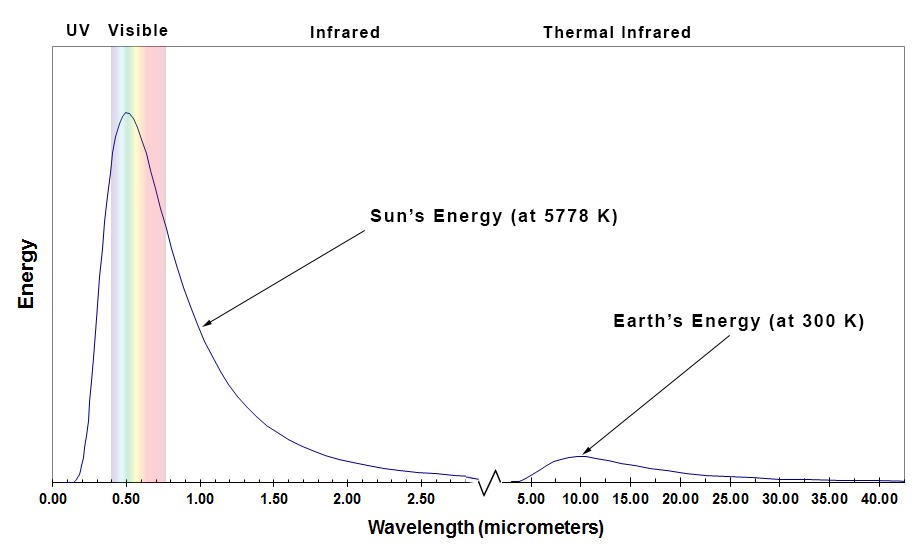
The y-axis of a blackbody chart represents the amount of energy radiated by a blackbody while the x-axis represent the wavelength. By looking at the magnitude of the curve (height), we can determine the energy radiated by a body at a specific wavelength. The area under the curve represents the total energy radiated across all wavelengths. By locating the peak (highest point) of the curve, we can determine at what wavelength the greatest amount of energy is emitted at. In the above graph, we can see that the Sun, with a temperature of approximately 5800 Kelvin, emits a significant of energy and that most of this energy is emitted between 0.4-0.7 micrometers in the visible wavelengths.
The Stefan-Boltzmann Law and Wien’s Displacement Law are important to remote sensing because they tell us how much energy a body will produce based on its temperature and where in the electromagnetic spectrum this energy will peak. This is important when designing and selecting sensors.