

Measuring Electromagnetic Radiation
Introduction
Electromagnetic radiation can act both as a wave or as a particle or photon. Electron radiation is released as photons or bundles of light energy that travel at the speed of light as waves. Therefore electromagnetic radiation can be described by wave theory, where it is represented by its speed, frequency and wavelength. As a particle, electromagnetic radiation can be described by particle theory which describes the energy level of a photon. Frequency, wavelength, and energy are all mathematically related such that if you know one, you can calculate the others.
All electromagnetic waves travel at a constant speed, known as the speed of light (c).
Speed of Light (c) = 300,000,000 meters per second or 3 x 10⁸ m/s (approximately)
When describing variables related to electromagnetic, we often encounter very large and very small numbers. For that reason, it is common to see these variables written in scientific notation or using metric prefixes. Scientific notation is a way to easily handle writing and working with very large numbers or very small numbers. The next section will go into scientific notation in greater detail.
A metric prefix is a unit prefix that precedes a basic unit of measure to indicate a multiple or fraction of the unit. You will see numbers written in both scientific notation and using metric prefixes frequently in remote sensing.
Table of Metric Prefixes
| Prefix | Symbol | Multiplier | Exponential |
| peta | P | 1,000,000,000,000,000 | 1015 |
| tera | T | 1,000,000,000,000 | 1012 |
| giga | G | 1,000,000,000 | 109 |
| mega | M | 1,000,000 | 106 |
| kilo | k | 1,000 | 103 |
| hecto | h | 100 | 102 |
| deca | da | 10 | 101 |
| Base Unit | 1 | 100 | |
| deci | d | 0.1 | 10-1 |
| centi | c | 0.01 | 10-2 |
| milli | m | 0.001 | 10-3 |
| micro | µ | 0.000001 | 10-6 |
| nano | n | 0.000000001 | 10-9 |
| pico | p | 0.000000000001 | 10-12 |
| femto | f | 0.000000000000001 | 10-15 |
| atto | a | 0.000000000000000001 | 10-18 |
Metric Prefixes are used to represent smaller and larger units by adding prefixes to the base units (e.g. meter, gram) to indicate the order of magnitude. Most units vary from the base unit by multiples of 10. For example, a kilometer is equal to 1000 meters, while a micrometer is equal to 0.000001 meter. The prefixes used in the metric system and their values are defined in the table above. However, the values you will most frequently encounter in remote sensing are micro and nano for wavelength and Tera, Giga and Mega for frequency. You don't need to memorize all of the prefixes, but you should know how to convert between prefixes and base units by looking them up in the above table.
Wavelength
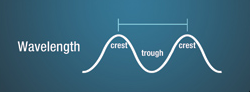
Electromagnetic waves have crests and troughs similar to those of ocean waves. The distance between crests is described as the wavelength. Wavelength is typically represented by the Greek letter lambda (λ). Since wavelength is measuring a distance, the base unit of measurement is a meter. Wavelength is commonly used to describe specific portions of the electromagnetic spectrum. For example, the visible and infrared portions of the electromagnetic spectrum are commonly described by their wavelength in nano or micrometers.
Common Wavelength Units
- Meters (m)
- Centimeters (cm)
- Nanometers (nm)
- Micrometers (μm)
Frequency
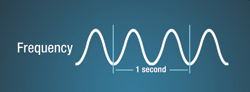
Frequency refers to the number of cycles of a wave passing a fixed point per unit of time. One wave—or one cycle per second is called a Hertz (Hz), after Heinrich Hertz who established the existence of radio waves. One Hertz can also be thought of as 1 wave cycle/second or 1/s.
Common Frequency Units
- Hertz (Hz) (1 wave cycle/second or 1/s)
- Kilohertz (KHz)
- Megahertz (MHz)
- Gigahertz (GHz)
Energy
An electromagnetic radiation can also be described in terms of its energy. Moving along the spectrum from long to short wavelengths, energy increases as the wavelength shortens. Photon energy is directly proportional to the frequency of the radiation. Consider a jump rope with its ends being pulled up and down. More energy is needed to make the rope have more waves. Energy is measured in Joules (J).
Relationship Between Wavelength, Frequency and Energy
Wavelength and frequency are inversely related, meaning as one increases the other decreases. The shorter the wavelength, the higher the frequency or the longer the wavelength, the lower the frequency. Understanding the characteristics of electromagnetic radiation in terms of their wavelength and frequency is crucial to understanding the information to be extracted from remote sensing data. The relationship between wavelength and frequency is described by the following formula:
c = λ x ν
c = Speed of Light (3 x 10⁸ m/sec )
λ = Wavelength in Meters
ν = Frequency in Hertz
While many characteristics of electromagnetic radiation can be described by wave theory, particle theory suggests that electromagnetic radiation is composed of many discrete units called photons. The energy of a photon is described by the follow equation:
E = h x v
E = energy of a photon (Joules (J))
h = Planck’s constant – 6.626 X 10 -34 Joule-Seconds
v = Frequency (Hz)
High frequency (short wavelength) electromagnetic radiation carries a lot of energy. Low frequency (long wavelength) electromagnetic radiation carries little energy. One of the implications of this relationship to remote sensing is that it is more difficult to detect the radiant energy of longer wavelength than shorter wavelengths (less energy to detect!).