

Electromagnetic Radiation
Introduction
Electromagnetic energy is a type of kinetic energy produced by the movement of electrically charged particles traveling through space.
Law of Conservation of Energy
The Law of Conservation of Energy states that energy can be transferred but not created or destroyed. Energy can be transferred in one of three ways:
- Conduction – transfer by physical contact
- Convection – transfer by movement
- Radiation – transfer of energy without the need of a medium
Electromagnetic energy transferred by radiation is known a electromagnetic radiation or EMR. EMR is the only energy that can travel through a vacuum – i.e. space. Light, electromagnetic waves, and radiation all refer to the same physical phenomenon: electromagnetic energy.
All objects warmer than absolute zero (-273° C) emit electromagnetic radiation (EMR). Objects also reflect and absorb EMR emitted by other objects. This means that the Sun, the Earth and even your computer monitor are reflecting and emitting a wide range of electromagnetic waves. The Sun is a major source of electromagnetic radiation on Earth, emitting energy across several regions of the spectrum. All of this is key to remote sensing because the Earth's surfaces reflect electromagnetic energy in unique ways.
Electromagnetic Waves
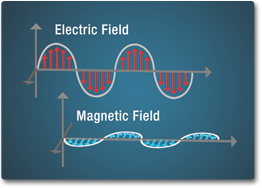
Image Credit: NASA
All electromagnetic radiation behaves in predictable ways according to the basics of wave theory. Electromagnetic waves are formed by the vibrations of electric and magnetic fields. Electromagnetic radiation consists of perpendicular electrical and magnetic fields. These fields vary in magnitude in a direction perpendicular to the direction in which the radiation is traveling. Both of these fields travel at a constant speed known as the speed of light (C). Electromagnetic waves differ from mechanical waves in that they do not require a medium to propagate. This means that in addition to be able to travel through air and solid materials, electromagnetic waves can also travel through the vacuum of space. Electromagnetic radiation is typically described in terms of its frequency, wavelength, or energy level.