

Electromagnetic Spectrum
Introduction
The entire range of electromagnetic waves is known as the electromagnetic spectrum. This includes electromagnetic energy ranging from gamma rays to radio waves.
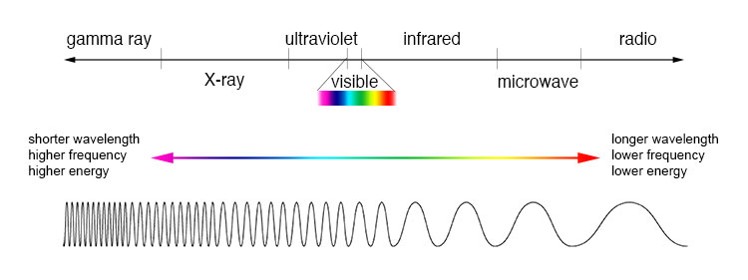
Regions of the Electromagnetic Spectrum
The electromagnetic spectrum is broadly classified into different named categories based on the wavelength and characteristics of the energy. The names like "microwave" or "infrared" were developed for convenience to describe electromagnetic radiation with similar characteristics, but there are no definitive dividing lines between one spectral region or the next. The only region in the electromagnetic spectrum that is relatively consistent in the wavelength definition is the visible spectrum, as it corresponds directly with to wavelengths that human eyes are sensitive to. The visible spectrum is a small window of the entire electromagnetic spectrum.
Gamma Rays (Wavelength < 10-12 meters)
Gamma rays have the shortest wavelengths (< 0.01 nanometers ) and the most energy of any region of the electromagnetic spectrum. Gamma rays are produces by the hottest objects in the universe, including neutron stars, pulsars, supernova explosions. Gamma rays can also be created by nuclear explosions. the majority of gamma rays generated in space are blocked by the Earth's atmosphere. This is a good thing as gamma rays are biologically hazardous.
X-Rays (Wavelength 10-8 to 10-12 meters)
X-Rays range in wavelength from 0.01 – 10 nm and are primarily generated from by super-heated gas from exploding stars and quasars. X-rays are able to pass through many different types of materials. X-rays are commonly used for medical imaging and for inspecting cargo and luggage. Similar to gamma rays, the Earth's atmosphere blocks x-ray radiation.
Ultraviolet (UV) (Wavelength 10-7 - 10-8 meters)
Ultraviolet (UV) light has wavelengths of approximately 1 – 380 nm. The Sun is a source of ultraviolet energy. The UV portion of the spectrum is subdivided into UV-A, UV-B, and UV-C. UV-C rays are the most harmful and are almost completely absorbed by our atmosphere. UV-B rays are the harmful rays that cause sunburn. Although UV waves are invisible to the human eye, some insects, such as bumblebees, can see them.
Visible (Wavelength ~ 10-7 meters)
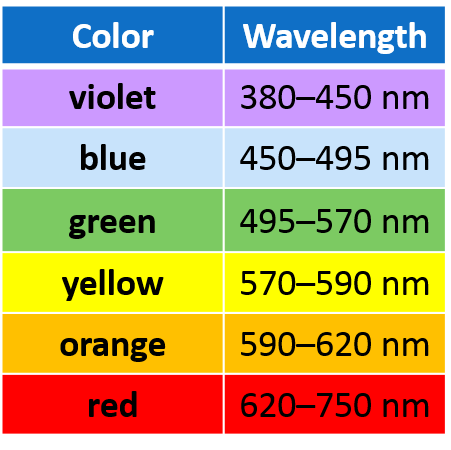 Visible light covers the range of wavelengths from 400 – 750 nm or 0.4 to 0.75 micrometers. This is the only region in spectrum that human eyes are sensitive to. The Sun emits the most radiation in the visible portion of the spectrum. Each individual wavelength within the spectrum of visible light wavelengths is representative of a particular color.
Light at the lower end of the visible spectrum, having a longer wavelength, about 750 nm, is seen as red; light in the middle of the spectrum is seen as green; and light at the upper end of the spectrum, with a wavelength of about 380 nm, is seen as violet. When all the wavelengths of the visible light spectrum strike your eye at the same time, the color white is perceived. The visible portion of the spectrum is used extensively in remote sensing and is the energy that is recorded using photography.
Visible light covers the range of wavelengths from 400 – 750 nm or 0.4 to 0.75 micrometers. This is the only region in spectrum that human eyes are sensitive to. The Sun emits the most radiation in the visible portion of the spectrum. Each individual wavelength within the spectrum of visible light wavelengths is representative of a particular color.
Light at the lower end of the visible spectrum, having a longer wavelength, about 750 nm, is seen as red; light in the middle of the spectrum is seen as green; and light at the upper end of the spectrum, with a wavelength of about 380 nm, is seen as violet. When all the wavelengths of the visible light spectrum strike your eye at the same time, the color white is perceived. The visible portion of the spectrum is used extensively in remote sensing and is the energy that is recorded using photography.
Infrared (Wavelength ~ 10-6 to 10-3 meters)
The infrared portion of the spectrum ranges from approximately 0.75 µm to 100 µm (750 nm - 10,000 nm) in wavelength. It is divided up into three main regions, Near Infrared (NIR): 0.7 – 1.3µm, Shortwave Infrared (SWIR): from 1.3 – 3 µm and the Far or Thermal Infrared from 3 - 100 µm. Infrared radiation is used extensively in remote sensing. Objects reflect, transmit, and absorb the Sun's near-infrared and shortwave radiation in unique ways and this can used to observe the health of vegetation, soil composition and moisture content. The region from 8 to 15 µm is referred to as thermal infrared since these wavelengths are best for studying the longwave thermal energy radiating from the Earth.
Microwaves (Wavelength ~ 10-3 to 10-1 meters)
Microwaves are essentially high frequency radio waves and have wavelengths that range 1mm to 1m. Different wavelengths or bands of microwaves are used for different applications. Mid-wavelength microwaves can penetrate haze, light rain and snow, clouds, and smoke are beneficial for satellite communication and studying the Earth from space. Radar technology sends pulses of microwave energy and senses the energy reflected back.
Radio Waves ((Wavelength >10-1meters)
Radio waves have the longest wavelengths in the electromagnetic spectrum with wavelengths ranging from approximately 1mm to several hundred meters. Radio waves are used to transmit a variety of data. Wireless networking, television and amateur radio all use radio waves. The use of radio frequencies are usually regulated by governments.