

Photogrammetry
Photogrammetry is the science of making measurements from photographs. This includes calculating distances and lengths, objects heights and area measurements. Photogrammetry has been around since the development of modern photography techniques. If the scale of an image is known, distances or lengths of objects can be easily calculated by measuring the distance on the photo and multiplying it by the scale factor.
Scale
Remember that scale is the ratio of the size or distance of a feature on the photo to its actual size. Scale for aerial photos is generally expressed as a representative fraction (1 unit on the photo equals "x" units on the ground). If the scale is known distances on the photograph can easily be transformed into real-world ground distances.
Calculating Distance and Area
Distance and Length
If the scale of an aerial photograph is known distances lengths and areas of features can easily be calculated. You simply measure the distance on the photo (photo distance) and multiply the distance by the scale factor. Remember that scale is always equal to the ratio of the photo distance to the ground distance.
Example:
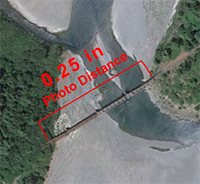
The scale of an aerial photograph is 1:15,000. In the photo you measure the length of a bridge to be 0.25 inches, what is the length of the bridge in feet in real life?

Area
It is important to remember that area is measured in square units. To determine rectangular area it is length multiplied by width, so if you measure both and convert these distances remember that if you are multiplying them together the resulting units are squared. For example, if an area is 100 meters by 500 meters, it is 50,000 square meters. Now if you wanted to change that number to square feet you wouldn't multiply by 3.28 (there are 3.28 feet per meter), you would multiply by 10.76 (3.28 x 3.28).
Example:
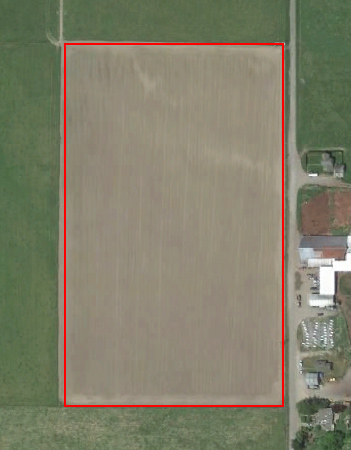
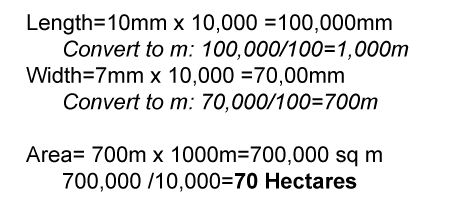
An aerial photograph has a scale of 1:10,000. On the photo, the length of a field is measured as 10 mm and the width 7mm. How big (in Hectares) is the field in real-life? Note that 10,000 square meters = 1 Hectare.
Calculating Object Heights
As with calculating scale, there are multiple methods to determine the height of tall objects (e.g. trees or buildings) in aerial photos. In single aerial photos the two primary methods are the relief/radial displacement method and the shadow methods.
Relief/Radial Displacement Method
The magnitude of the displacement in the image between the top and the bottom of an object is known as its relief displacement and is related to the height of the object and the distance of the object from the principal point. This method can only be used if the object that is being measured is be far enough from the principal point to measure the displacement and the top and bottom of the object are visible in the photo.

Example: The length of a a displaced building is measured at 2.01 mm and the radial distance to the principal point is 56.43 mm. If the the flying height about the surface is 1220 m, what is the height of the building?

Shadow Method
If you can measure the length of a shadow and know the angle of the sun, the height of the object can be calculated using simple trigonometry.
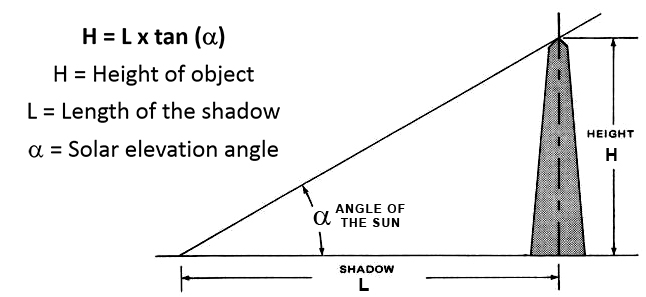
If you know when and where the aerial photo was taken you can determine the angle of the sun using the NOAA Solar Calculator. When using this calculator you want to use the solar elevation angle (El) for your calculations. This is the angle of the sun at the time and location specified.
