

Atmospheric Absorption & Transmission
Introduction
The Sun is the primary source of electromagnetic radiation on Earth. The Earth is constantly bombarded with electromagnetic radiation (EMR), but before the electromagnetic energy from the Sun reaches the Earth’s surface, it must pass through the atmosphere. The atmosphere protects us from exposure to higher energy radiation that can be harmful to life – i.e. X-Ray and Gamma Rays. As the energy passes through the atmosphere, it interacts with the molecules and particles present in the atmosphere. In the atmosphere, EMR is scattered or reflected, absorbed and a portion of the energy passes through the atmosphere to reach the Earth's surface.
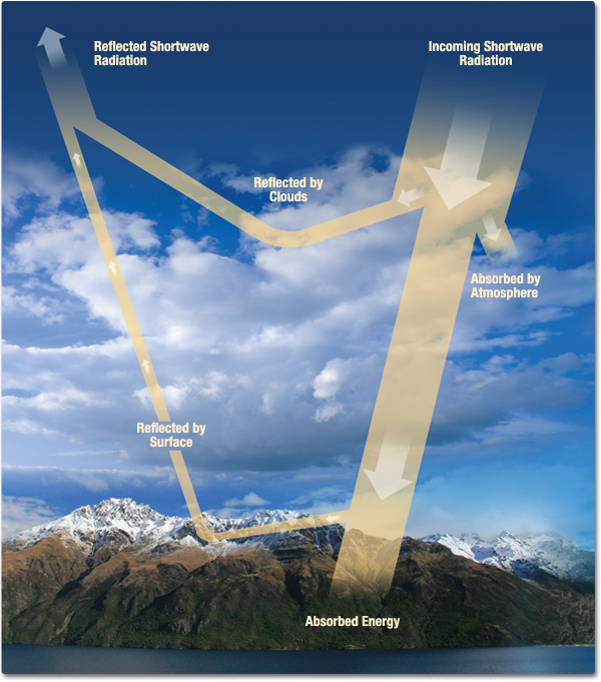 The incoming radiation from the Sun can be reflected by clouds, absorbed by the atmosphere, and allowed to pass through to the Earth's surface: Image Credit: NASA
This has significant implications to remote sensing, as most radiation detected by passive remote sensors passes through the atmosphere where it interacts with the molecules and particles in the atmosphere. In portions of the electromagnetic spectrum, significant amounts of energy are absorbed by the Earth's atmosphere, with very little of the energy reaching the Earth's surface. All radiation detected by remote sensors passes through the atmosphere for some distance, this distance is known as path length. The path length can vary, it could be a short path (i.e. hand-held camera) or a very long path (satellite based sensors).
Absorption
A portion of the incoming solar radiation is absorbed by gases in the Earth's atmosphere. These gases absorb electromagnetic energy at certain wavelengths, therefore in certain portions of the electromagnetic spectrum very little energy is absorbed (for example the visible) while in other portions like the Ultraviolet, nearly all incoming energy is absorbed. The portions of the spectrum that are absorbed by atmospheric gases are known as absorption bands.
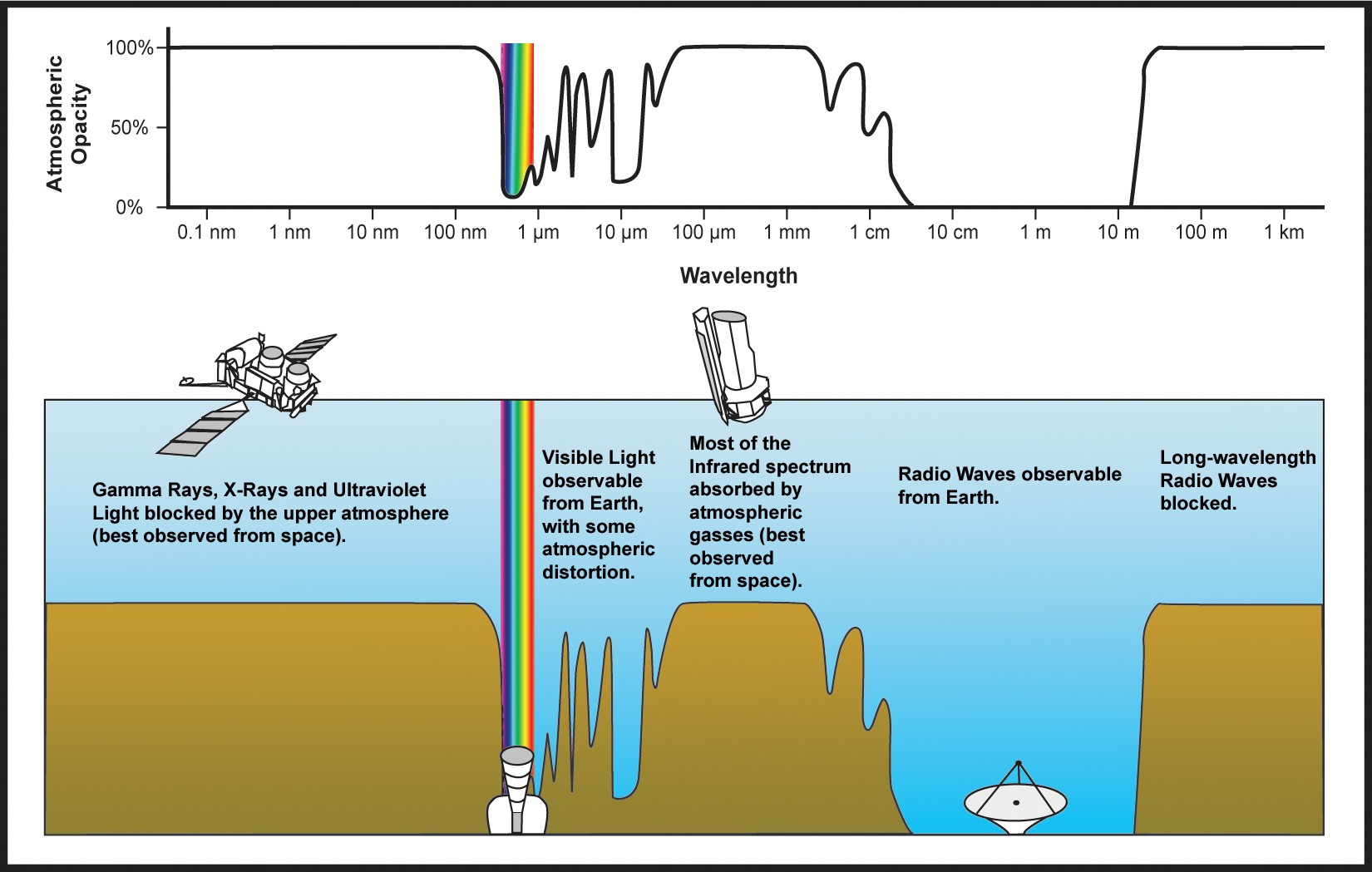 Atmospheric absorption percentages throughout the electromagnetic spectrum. Image Credit: NASA
The primary gases that are responsible for the majority of the atmospheric absorption of energy are water vapor, carbon dioxide, and ozone.
- Water Vapor (H2O): Very strong absorber in 5.5-7.0 μm range and > 27 μm. Note that water vapor in the atmosphere is also variable in time and space. This means absorption rates may vary depending on the location and the time of day and year.
- Carbon Dioxide (CO2) : Primarily absorbs radiation in the mid and far (thermal infrared) infrared portions of the spectrum
- Ozone (O3) : Absorbs strongly in the UV portion of the spectrum (very short wavelengths) and is responsible for protecting us from damaging radiation that causes skin cancer.
Transmission
In contrast to the absorption, transmission is when electromagnetic energy is able to pass through the atmosphere and reach the Earth's surface. Visible light, largely passes (or is transmitted) through the atmosphere.
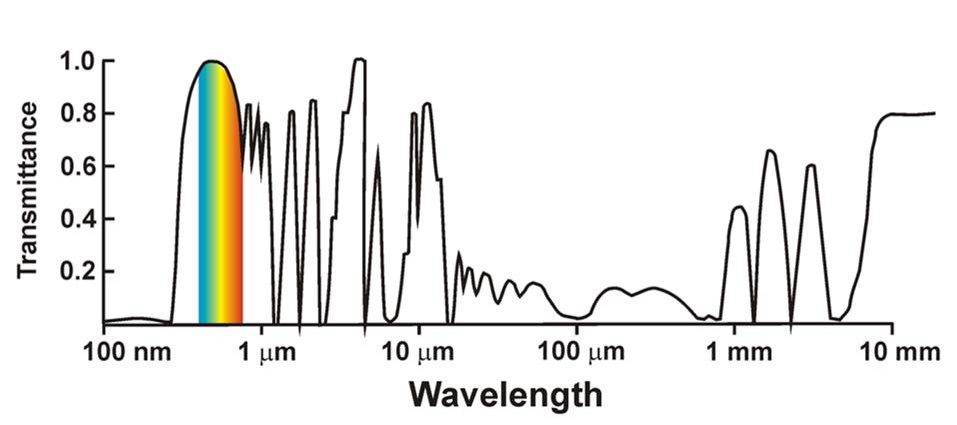 The above graph shows the transmittance of electromagnetic radiation across the spectrum. Values close to 1, represent 100% transmittance, indicating the all radiation is able to pass through the atmosphere at the given wavelength. Conversely, values close to 0 indicate that all radiation is blocked and no radiation is able to pass through the atmosphere at the given wavelength.
 Some types of electromagnetic radiation easily pass through the atmosphere, while other types do not. The ability of the atmosphere to allow radiation to pass through it is referred to as its transmissivity, and varies with the wavelength of the radiation. The gases that comprise our In contrast to the absorption bands, there are areas of the electromagnetic spectrum where the atmosphere is essentially transparent (with minimal to no absorption of radiation) to specific wavelengths. These regions of the spectrum or wavelengths are known as "atmospheric windows" since they allow the radiation to pass through the atmosphere to Earth's surface. For example visible light and radio waves can pass relatively freely through the atmosphere, while X-Rays can not.
It is always important to keep atmospheric windows in mind when designing and selecting senors for remote sensing applications. Most remote sensing instruments on aircraft or satellite platforms operate in one or more of these atmospheric windows.